Key Takeaways
- Learning how to jump-start a car properly is essential to avoid injury or damage to your vehicle.
- Always connect the jumper cables in the correct order and use an unpainted metal surface for the final ground connection.
- If the battery is swollen, leaking, or heavily corroded, do not attempt a DIY jump-start—call a road rescue service instead.
- When a jump-start doesn’t work, the issue may be a bad alternator or a deeper electrical fault. Call for professional help and diagnosis if needed.
How to Jump-Start a Car Safely
Stuck in an underground carpark with a car that won’t start? Whether it’s after a long day at work or a quick grocery run, a flat battery can throw your plans off completely. If you’ve got jumper cables, the right knowledge, and a willing helper, knowing how to jump-start a car can get you moving again.
Here’s what you need to know.
How to Jump-Start a Car in 5 Steps
Before you begin, make sure you have jumper cables and access to another vehicle with a charged battery. Safety first—both cars should be in park (or neutral for manual cars), and the ignition should be off.
1. Position the Cars
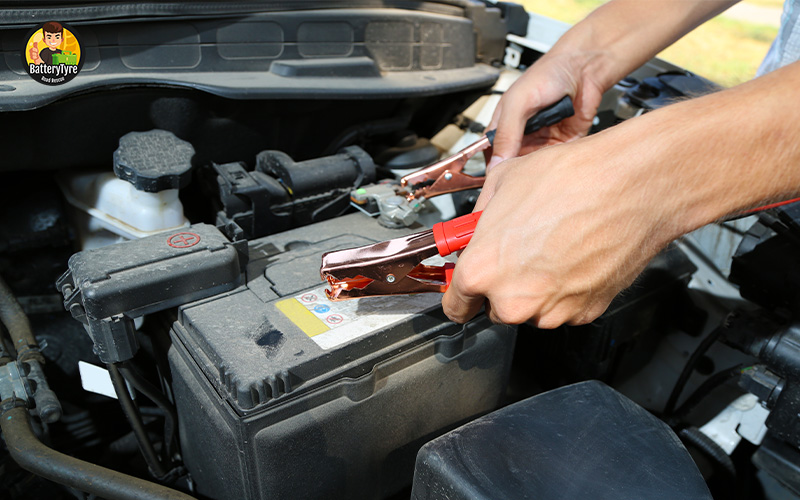
Position the booster car close to the vehicle with the dead battery—preferably front to front—while ensuring the two vehicles are not in contact. Switch off both engines and pop the hoods.
2. Connect the Red (Positive) Cable
Clip one end of the red cable to the positive terminal (+) of the dead battery. Next, connect the other end to the positive terminal of the working battery.
3. Connect the Black (Negative) Cable
Clip one end of the black cable to the negative terminal (–) on the working battery. The other end should go onto an unpainted metal surface on the dead car—like a bolt or bracket on the engine block. Never connect this end directly to the dead battery, as it could cause sparks or even an explosion.
4. Start the Booster Car
Let the booster car run for a couple of minutes to transfer some charge. After that, attempt to start the engine of the car. If it cranks slowly or doesn’t start right away, wait another minute and try again.
5. Remove the Cables in Reverse Order
Once the engine starts, leave both cars running. Then remove the jumper cables in reverse order:
- First, remove the black cable from the metal surface
- Then the black from the booster battery
- Followed by the red cable from the booster battery
- Finally, the red from your revived car
Should You Jump-Start a Car Yourself?
While knowing how to jump-start a car can be useful, it’s not always the safest option. If you don’t have jumper cables, another car, or you’re unsure about your vehicle’s condition, it’s better to hold off. Moreover, signs like a swollen battery casing, leaking fluid, or excessive corrosion could mean deeper electrical issues.
Attempting a DIY jump-start in these cases might cause damage or even injury. That’s when it’s safer to call a professional to jump-start your car. In Singapore’s hot and humid climate, car batteries tend to degrade more quickly, and expert help ensures the problem is accurately diagnosed and handled safely.
What If Jump-Starting Doesn’t Work?
If your car still won’t start after a few attempts—or if the dashboard stays entirely dark—the issue might go beyond a flat battery. A completely discharged battery, faulty starter, or deeper electrical fault could be the culprit. In these cases, it’s best to leave troubleshooting a dead battery to a professional.
Even a new battery that keeps failing could point to a bad alternator or a parasitic power drain. A mobile car battery and road rescue team can test your charging system, identify the root cause, and replace the battery on the spot if needed—no towing required.
Conclusion: Be Ready, Stay Safe
Knowing how to jump-start a car is a useful skill for any driver—but just as important is recognising when it’s safer to leave it to the professionals. In Singapore’s dense, fast-paced environment, a quick decision can make all the difference between a smooth recovery and costly damage.
Whether it’s troubleshooting car problems, jump-starting an unresponsive vehicle, or replacing a busted tyre, Battery Tyre Road Rescue is here to help. Our team offers fast, islandwide support—so you’re never left stranded.
Contact us today to learn more about our services.